How to Spot a Rare Diecast Aircraft Model

Some diecast aircraft remain widely available for years, while others become difficult to find soon after release. However, an aircraft being old, discontinued or described as a limited edition does not automatically make it rare.
True rarity depends on a combination of factors, including how many examples were produced, how frequently they appear for sale, how many survive in complete condition and whether collectors are actively looking for that exact release.
This guide explains how to spot a rare diecast aircraft model, distinguish genuine scarcity from seller marketing and assess whether a particular Corgi, Hobby Master, Century Wings or other model is genuinely difficult to obtain.
What Makes a Diecast Aircraft Model Rare?
A rare diecast aircraft model is one that appears infrequently relative to collector demand. This is different from a model simply being old, retired or expensive.
A model may be rare because:
- Only a small number were produced
- It was distributed in a limited market
- It sold out quickly when originally released
- Many surviving examples are damaged or incomplete
- It represents a particularly desirable aircraft or scheme
- Collectors rarely offer their examples for sale
- It was withdrawn, altered or replaced during production
Rarity is therefore best assessed using several different pieces of evidence rather than relying on one description, certificate or sales listing.
Rare Does Not Always Mean Valuable
Rarity and value are related, but they are not the same thing. A model can be genuinely scarce while attracting little collector demand. Conversely, a model produced in relatively large numbers may command a strong price because many collectors want it.
A model’s value is normally influenced by both supply and demand:
- Supply: How many examples are available?
- Demand: How many collectors want that exact release?
- Condition: How many surviving examples remain undamaged?
- Completeness: Are the original accessories, stand and paperwork still present?
This distinction is important because phrases such as “rare”, “limited edition” and “hard to find” are sometimes used loosely in sales listings.
Start With the Exact Product Code
The manufacturer’s product code is the most important starting point when researching a diecast aircraft model.
Corgi Aviation Archive releases generally use an AA product code, while Hobby Master aircraft usually carry an HA code. Other manufacturers have their own identification systems.
The product code identifies the exact release, including its aircraft variant, squadron, markings and production configuration. Searching only for the aircraft name can produce misleading results because manufacturers may release many models of the same aircraft.
For example, two models may both represent an F-4 Phantom in 1:72 scale but depict different operators, squadrons, pilots or historical periods. One release may be readily available while the other rarely appears on the second-hand market.
The product code may be found on:
- The outer box
- The barcode label
- The underside of the aircraft
- The certificate or collector card
- The instruction sheet
- An original manufacturer or retailer listing
Always confirm that the model and box carry the same reference before researching rarity or value.
Check the Original Production Quantity
A low production quantity can contribute to rarity, but production figures need to be interpreted carefully.
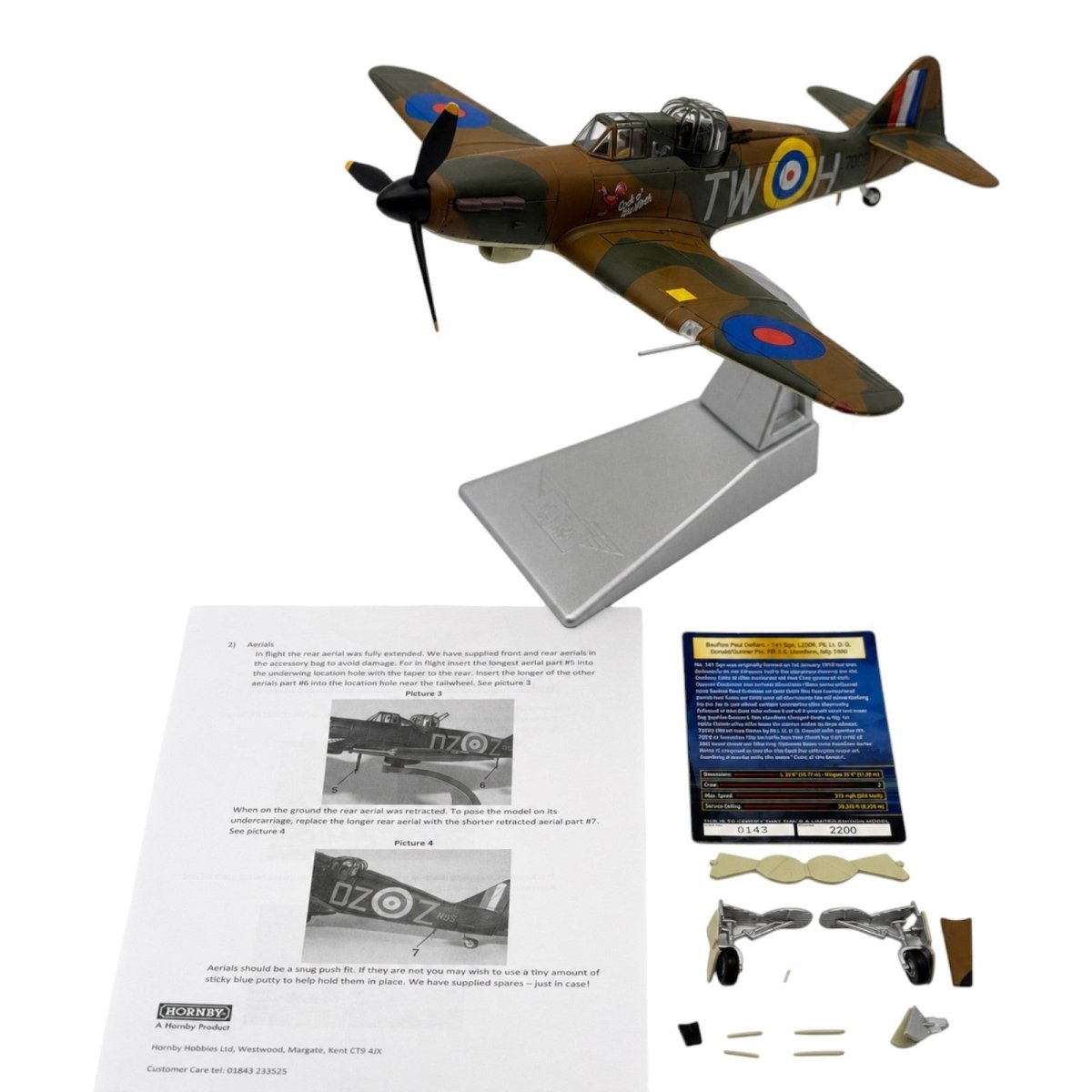
Some Corgi Aviation Archive releases include a numbered certificate showing both the individual certificate number and the stated edition size. For example, a certificate might identify one model as number 259 from a production run of 1,000.
Hobby Master models are normally produced in finite batches, but they do not generally use the same individually numbered certificate system. Production information may instead come from manufacturer announcements, distributor information, collector archives or specialist reference material.
Consider the following:
- Was the stated number the complete worldwide production?
- Were further production batches released later?
- Was the model distributed worldwide or only in selected markets?
- Did the manufacturer produce another very similar version?
- Are the production figures confirmed or only repeated by sellers?
A production run of 1,000 may be relatively limited, but it does not guarantee rarity if collector demand is low and many examples remain available.
Our guide to limited-edition diecast aircraft, certificates and production numbers explains how the main manufacturers approach limited releases.
Do Not Rely on Certificate Numbers Alone
A low individual certificate number can be appealing, but it does not normally mean that the model itself is rarer than another example from the same production run.
Model number 25 of 1,000 and model number 825 of 1,000 are still part of the same stated edition. Some collectors may personally prefer very low numbers, matching numbers or significant dates, but the production quantity is generally more relevant than the individual sequence number.
Certificates can still matter because they form part of the original release. A complete model with its correct certificate may be more desirable than an otherwise identical example where the certificate has been lost.
Check How Often the Exact Model Appears for Sale
One of the best practical indicators of rarity is how frequently the exact product code appears on the market.
Search across:
- Specialist diecast model retailers
- General online marketplaces
- Auction platforms
- Collector groups and forums
- Completed auction catalogues
- Previously sold retailer archives
Our previously sold model archive contains examples of discontinued diecast aircraft that have passed through The Collectables Vault and may help with identification and research.
Finding no current listings does not prove that a model is rare. It may simply mean that no example is available at that particular moment. Look at the market over a longer period and note how often complete examples appear.
Similarly, finding several listings does not necessarily mean the model is common. Multiple examples could come from one recently released collection or a single dealer’s remaining stock.
Compare Current and Previously Sold Examples
Current listings and previously sold examples can both provide useful information, but neither should be considered in isolation.
When comparing prices and availability, check that each example has:
- The same product code
- The same aircraft markings
- A similar model condition
- A comparable box condition
- The correct display stand
- The same accessories and paperwork
- No undisclosed repairs or replacement parts
A damaged or incomplete model is not directly comparable with a complete example that has been individually inspected and retains all of its original contents.
Use several sources where possible. One unusually high or low result may not represent the wider collector market.
Discontinued Does Not Automatically Mean Rare
Most collectable diecast aircraft eventually become discontinued because manufacturers move on to new subjects and colour schemes.
A discontinued model is simply no longer in normal production. It may still remain widely available if:
- The original production run was large
- Retailers retained stock for several years
- Collector demand was limited
- Many examples regularly return to the second-hand market
- A later release offers a similar or improved alternative
Discontinued status becomes more meaningful when new stock has disappeared, second-hand examples appear infrequently and collectors continue actively searching for the exact release.
Look for Regional and Exclusive Releases
Some diecast aircraft were produced for particular retailers, distributors, collector clubs, countries or events. These releases may have had a more limited distribution than standard worldwide models.
Examples can include:
- Retailer-exclusive colour schemes
- Collector club editions
- Convention or airshow releases
- Models produced for a specific national market
- Special packaging variants
- Commemorative editions
Limited distribution can make a model difficult to find outside its original market. However, the release still needs sufficient collector demand to achieve a strong value.
Special Markings Can Increase Collector Demand
Collectors often favour models with historically significant or visually distinctive markings.
Popular subjects may include:
- Aircraft flown by recognised pilots or aces
- Battle of Britain schemes
- D-Day invasion stripes
- Anniversary and commemorative liveries
- Special tail artwork
- Tiger Meet and display schemes
- Famous squadron markings
- Aircraft connected with notable missions
- Unusual aggressor or test aircraft schemes
These markings do not automatically make a model rare, but they can increase demand. A comparatively common release may become difficult to obtain when collectors particularly value the aircraft or scheme represented.
You can explore the stories connected with individual aircraft through our History Behind the Models articles.
Popular Aircraft Can Become Harder to Find
Some aircraft types have consistently strong collector followings. Releases depicting these subjects may sell more quickly and return to the market less frequently.
Popular examples often include:
- Supermarine Spitfire
- Avro Lancaster
- de Havilland Mosquito
- English Electric Lightning
- F-4 Phantom II
- F-14 Tomcat
- F-15 Eagle
- F-16 Fighting Falcon
- F-22 Raptor
- SR-71 Blackbird
However, the aircraft type alone is not enough. The exact variant, operator, pilot, squadron and markings can make one release significantly more desirable than another.
Unusual Variants and One-Off Toolings
A model may be scarcer when it represents a version that manufacturers rarely reproduce.
This might include:
- An unusual aircraft sub-variant
- A prototype or test aircraft
- A trainer or reconnaissance version
- A short-lived colour scheme
- An aircraft from a smaller operator
- A tooling used for only a small number of releases
By contrast, aircraft produced repeatedly using the same tooling may provide collectors with several alternatives. This can reduce demand for one particular release unless its markings or historical connection are especially desirable.
Errors, Withdrawn Releases and Production Variations
Occasionally, a model is altered, withdrawn or corrected during production. This can create separate versions of what initially appears to be the same release.
Possible variations include:
- Corrected aircraft markings
- Different packaging
- Changes to certificates or paperwork
- Alternative weapons or accessories
- Different display stands
- Revised paint colours
- Changes made for legal or historical reasons
Early or withdrawn versions can be scarce, but claims about production errors should be verified carefully. A difference may simply result from a missing part, fading, a previous repair or an accessory taken from another release.
Condition Can Make a Common Model Rare in Practice
A model itself may not be exceptionally rare, but examples remaining in excellent condition can become difficult to find.
Over time, models may develop:
- Paint chips and edge wear
- Packaging rub marks
- Broken aerials or pitot tubes
- Damaged landing gear
- Detached weapons
- Clouded or scratched canopies
- Previous glue repairs
- Paint cracking or metal deterioration
For fragile or older releases, a genuinely complete and well-preserved example may be much less common than the total production quantity suggests.
Read our condition grading guide to see how The Collectables Vault assesses model and box condition separately.
Completeness Is an Important Part of Rarity
Small accessories are easily lost when models pass through several collections. A model may survive while its original stand, weapons, landing gear, certificate or alternative display parts disappear.
A complete release may originally include:
- The correct display stand and adaptor
- Removable landing gear
- Open and closed undercarriage doors
- Missiles, bombs and fuel tanks
- Alternative weapon configurations
- Pilots or crew figures
- Aerials and pitot tubes
- Instructions
- A limited-edition certificate or collector card
- Original internal packaging
An aircraft may appear attractive on display while still being incomplete as originally supplied.
Our full guide explains how to check whether a pre-owned diecast aircraft is complete.
Original Packaging Can Become Scarcer Than the Model
Boxes and internal packaging are frequently discarded, damaged or separated from their aircraft. As a result, a fully boxed example may be significantly harder to find than an unboxed model.
Check whether the model retains:
- The correct outer box
- The original polystyrene or blister tray
- Accessory bags
- Card inserts
- Instructions
- Certificate or collector card
- Protective tissue or internal covers where applicable
Packaging condition also matters. Severe crushing, water damage, fading or missing internal supports can affect desirability even when the aircraft itself remains undamaged.
Manufacturer Reputation Can Influence Demand
Established manufacturers often have dedicated collector followings, but the brand name alone does not make every release rare.
Well-known diecast aircraft manufacturers include:
- Corgi Aviation Archive
- Hobby Master
- Century Wings
- Gemini Aces
- Gemini Jets
- JC Wings
- Dragon Wings
- Franklin Mint
- Witty Wings
Some manufacturers specialise in particular aircraft, eras or scales. Collector demand may be especially strong when one brand is considered to have produced the most desirable version of a particular aircraft.
You can browse our other diecast aircraft brands for models beyond Corgi and Hobby Master.
Do Not Trust the Word “Rare” Without Evidence
The word “rare” is frequently used in sales titles, but it should not be accepted as proof.
Before agreeing that a model is rare, ask:
- What is the exact product code?
- Is the production quantity known?
- How often has the model appeared recently?
- Are several examples currently available?
- Is the model complete?
- Does it retain its correct box and stand?
- Is there genuine collector demand?
- Are claims supported by catalogues, archives or reliable references?
A listing description is only one source of information. The strongest assessment comes from combining manufacturer information, historical listings, collector references and evidence from the wider market.
Signs That a Model May Be Genuinely Rare
A diecast aircraft is more likely to be genuinely rare when several of the following apply:
- The exact release had a confirmed low production quantity
- It was distributed only in a limited market
- It has been discontinued for a significant period
- Complete examples appear very infrequently
- Collectors actively search for the release
- It represents an unusual aircraft variant or scheme
- Few examples survive in strong condition
- It retains accessories that are commonly missing
- Its original box and paperwork are difficult to find
- Several reliable sources support the rarity claim
No single point provides absolute proof. The strongest cases normally combine restricted supply, limited availability and continuing collector demand.
How to Research a Potentially Rare Model
Use the following process when investigating a diecast aircraft:
- Confirm the manufacturer and exact product code.
- Check that the model matches its box and paperwork.
- Search for the original manufacturer or catalogue information.
- Look for a confirmed production quantity.
- Search current retailer and marketplace listings.
- Check previously sold examples over a reasonable period.
- Compare model condition, box condition and completeness.
- Look for collector discussions about the exact release.
- Check whether similar alternative releases exist.
- Consider both scarcity and genuine collector demand.
Keep notes and save the product code. Small differences between two releases can substantially affect their availability and desirability.
Frequently Asked Questions
Does Limited Edition Mean a Diecast Aircraft Is Rare?
No. Limited edition means that production was restricted in some way, but the stated quantity may still be large enough to satisfy collector demand. Availability and demand must also be considered.
Are Discontinued Diecast Aircraft Always Valuable?
No. Most releases eventually become discontinued. A retired model may remain readily available or have limited collector demand.
Does a Low Certificate Number Increase Value?
Some collectors prefer low numbers, but every certificate within the same stated edition belongs to the same production quantity. Condition, completeness and demand are normally more influential.
Can a Model Be Rare Without Its Box?
Yes, the aircraft itself may still be rare. However, a complete boxed example may be significantly scarcer and more desirable than an unboxed or incomplete model.
Why Are Some Common Aircraft Models Expensive?
A popular aircraft, squadron or colour scheme can create high collector demand even when the original production quantity was not especially small.
How Can I Find the Value of a Rare Diecast Aircraft?
Confirm the exact product code and compare several genuinely comparable examples. Account for the model’s condition, box, completeness, repairs and current availability.
Our guide to researching the value of a diecast aircraft model explains the process in more detail.
Final Thoughts
Spotting a rare diecast aircraft model requires more than finding the words “limited edition” on the box or “rare” in a sales title.
Begin with the exact product code, investigate the original production and distribution, monitor how often complete examples appear and consider whether collectors actively want that particular release.
Condition, completeness and original packaging are equally important. A model produced in reasonable numbers may still be difficult to find with every accessory, certificate and packaging component intact.
At The Collectables Vault, pre-owned models are individually inspected, graded and photographed. Known missing parts, repairs and condition issues are included in the product description so collectors can assess each release accurately.
You can browse our current ranges of Corgi Aviation Archive models, Hobby Master aircraft and other collectable diecast aircraft brands.
You can also explore our previously sold model archive or visit the Collector Guides and Articles hub for more identification, buying and model-care advice.

Written by Jay Sawyer